If you’ve watched your Search Console impressions stay flat while clicks quietly slide, you’re not imagining it. Research increasingly confirms that Google AI Mode sends less clicks to websites, even when rankings hold steady — and for a lot of businesses, that’s a bigger problem than losing a ranking ever was.As more users get complete answers directly in search results, Google AI Mode sends less clicks to publishers and business websites, making organic traffic harder to capture.
I tested this myself before writing a word of this post. I compared how a target query looked in traditional search versus AI Mode, then watched what happened in Search Console over the following weeks. The page kept its visibility. The clicks didn’t.
Why Google AI Mode Sends Less Clicks (Even When Rankings Don’t Move)
Here’s the part that surprised me most: the issue isn’t rankings collapsing. It’s Google answering the question before the user ever reaches your page. The main reason Google AI Mode sends less clicks is that users can often find enough information without opening a traditional organic result.
When AI Mode or AI Overviews can fully satisfy an informational query directly on the results page, there’s simply less reason for someone to click through. The page isn’t being outranked — it’s being made optional.
This lines up with what independent research has found. Ahrefs analyzed 300,000 keywords using Google Search Console data and found that AI Overviews reduced clicks to top-ranking content by 34.5% in an April 2025 study. When they re-ran the same analysis with December 2025 data, the presence of an AI Overview correlated with a 58% lower average clickthrough rate for the top-ranking page.
It gets worse at the search-behavior level. SparkToro’s 2026 research, based on Similarweb clickstream data, found that 68.01% of U.S. Google searches ended without a click in the first four months of 2026, up from 60.45% in 2024. A separate randomized field experiment involving over 1,000 U.S. participants found that when AI Overviews appeared, organic clicks dropped 38% and zero-click searches jumped from 54% to 72%.
A Real Example: Ranking Well, Clicking Poorly
One page I worked on was already ranking strongly for a high-intent informational question. After AI-generated answers became prominent for that query, the page kept its position and its impressions — but clicks began dropping. This experience shows why Google AI Mode sends less clicks even when a page continues to rank well and maintain strong search visibility.
That’s when it clicked (no pun intended): this wasn’t a ranking problem. It was a click-intent problem. Google was answering enough of the query on the SERP itself that visiting the site stopped feeling necessary.
That reframing changed how I approached content from that point forward — less “how do I rank for this,” more “why would someone still bother clicking through.”
Informational vs. Commercial Queries: Where the Damage Is Worst
Not every query type takes the same hit. Here’s how the impact tends to break down: Understanding which searches are most affected helps explain why Google AI Mode sends less clicks for some types of content more than others.
| Query Type | Typical AI Mode Impact | Why |
| Broad informational (“what is X”) | Severe click loss | AI can fully answer in a few sentences |
| Definitional / how-it-works | Severe click loss | Low need for depth or nuance |
| Comparison / “best X for Y” | Moderate click loss | Users still want validation, reviews, specifics |
| Product / service / transactional | Lower click loss | Users need to complete an action on-site |
| Local business queries | Lower click loss | Decisions require location, trust, direct contact |
This is exactly why blanket panic isn’t the right response. The risk is real, but it’s concentrated.
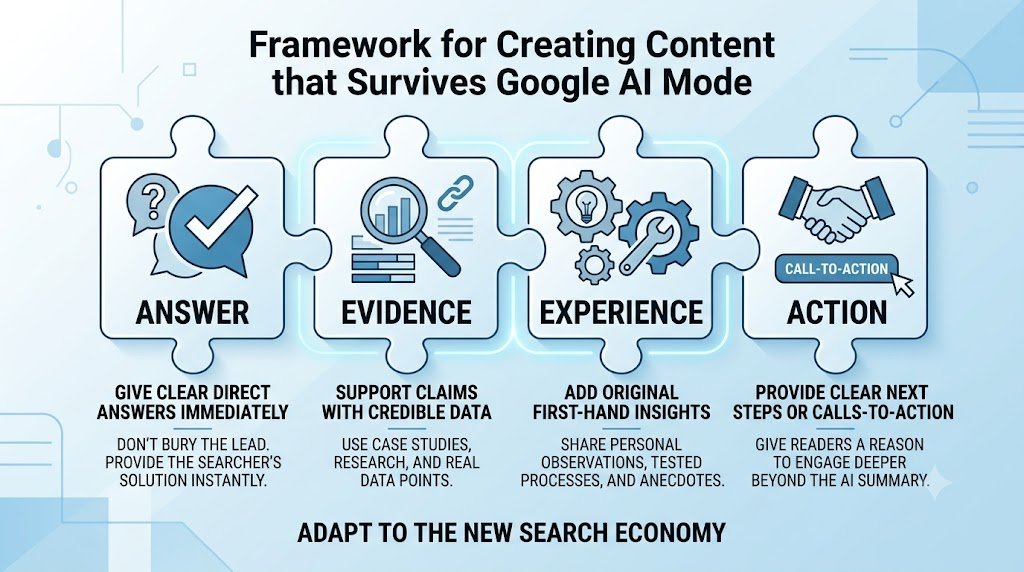
The Framework I Use: Answer → Evidence → Experience → Action
Instead of chasing more content, I use a simple four-part framework before publishing or updating anything: When Google AI Mode sends less clicks, your content needs to offer something beyond the basic answer available directly on the search results page.
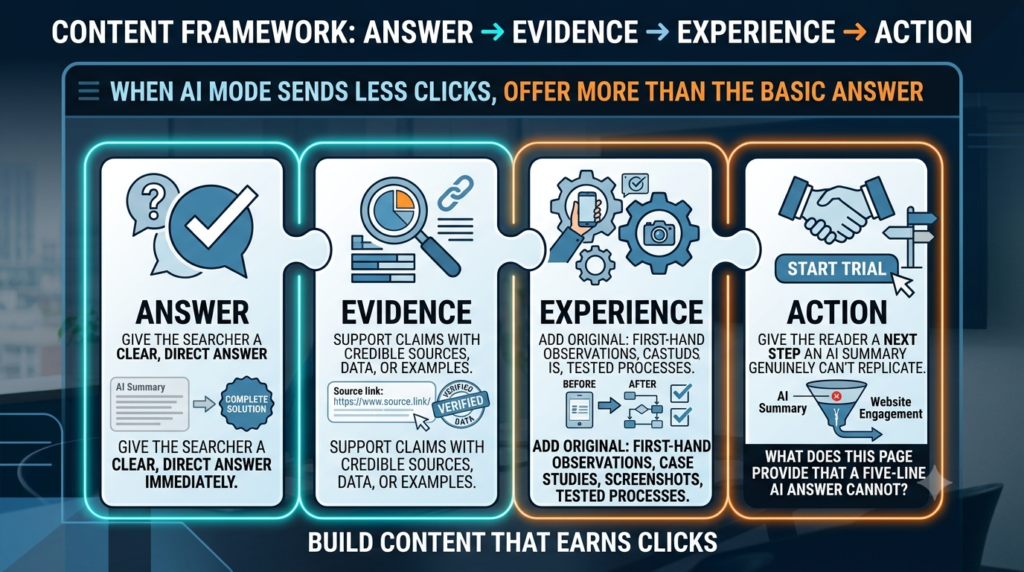
- Answer — Give the searcher a clear, direct answer immediately. Don’t bury it.
- Evidence — Support claims with credible sources, data, or examples, not assumptions.
- Experience — Add something original: first-hand observations, case studies, screenshots, tested processes.
- Action — Give the reader a next step an AI summary genuinely can’t replicate.
Before I publish anything now, I ask one question: what does this page provide that a five-line AI answer cannot? If I can’t answer that clearly, the content needs more original value, not more length.
The Most Common Mistake I See
Most businesses respond to AI Mode by producing more generic content — more AI-written articles, more FAQ sections stuffed in for the sake of it, more attempts to “format for AI.” That approach usually backfires, because it makes content even easier for an AI system to summarize and even less reason for anyone to click through.
The fix isn’t more content. It’s more original value inside the content you already have.
What Original, Click-Worthy Content Looks Like
- Step-by-step processes based on actual work, not theory
- Common mistakes you’ve personally seen clients or users make
- Direct, opinionated takes based on experience — not hedged summaries
- Screenshots, data, or examples tied to real outcomes
- Content connected to a specific service, product, or decision point
Is AI Mode a Real Threat or a Wake-Up Call?
Honestly, both — and the answer depends heavily on your query type. For broad informational searches, the risk of losing the click is real and well-documented. For product, service, transactional, or local queries, there’s still a strong reason for someone to land on your site.
The better response isn’t abandoning SEO. It’s asking a sharper question: why should someone visit my website if Google can already answer the basic version of their question?
Where This Advice Has Limits
This approach isn’t universal. It’s worth being upfront about that:
- Simple factual or reference sites have less room to add first-hand experience
- Commodity products are harder to differentiate meaningfully
- Highly regulated industries may be constrained in how much opinion or experience they can share
- Original content improves your odds — it doesn’t guarantee AI citations or protect every page from every algorithm shift
Treat this as a content strategy, not a guaranteed formula. Monitor your own Search Console data, identify which specific pages are losing clicks, and focus your effort where you actually have something valuable to add.
FAQ
Does Google AI Mode really reduce website clicks?
Yes. Research from Ahrefs found AI Overviews correlate with a 58% lower clickthrough rate for the top-ranking page, and broader zero-click search data shows the trend accelerating industry-wide.
Will my rankings drop because of AI Mode?
Not necessarily. Many pages keep their rankings and impressions but see clicks decline — the content is being summarized rather than outranked.
What type of content is most at risk?
Broad, purely informational content is most exposed. Transactional, local, and decision-heavy queries tend to hold up better.
Can I “beat” AI Mode with better SEO formatting alone?
No. Formatting for AI citation can help visibility, but it doesn’t solve the click problem. Original experience and a clear reason to visit are what drive clicks.
Does Google AI Mode send less clicks to websites?
Yes, research indicates that Google AI Mode sends less clicks for some searches, particularly when AI-generated answers satisfy informational intent directly in the search results.
Key Takeaways
The evidence suggests that Google AI Mode sends less clicks when AI-generated answers satisfy the user’s search intent without requiring a website visit.
- Google AI Mode sends less clicks primarily by satisfying informational intent directly on the results page, not by pushing pages out of rankings.
- Independent research (Ahrefs, SparkToro) confirms a real, measurable, and worsening click decline.
- Transactional, local, and product-related queries are more resistant than broad informational ones.
- Use the Answer → Evidence → Experience → Action framework to build content that gives readers a genuine reason to click through.
- This is a strategy for reducing risk, not a guarantee — track your own data and prioritize accordingly.
On-Page & Publishing Notes
Internal Linking Opportunity: Link to a related post on your site about E-E-A-T content strategy or SEO content audits.
External Reference (do-follow): Ahrefs: AI Overviews Reduce Clicks by 58%
Suggested Images & Alt Text:
- Chart comparing pre/post AI Overview CTR — Alt: “Chart showing Google AI Mode sends less clicks to top-ranking pages”
- Screenshot-style graphic of the Answer → Evidence → Experience → Action framework — Alt: “Framework for creating content that survives Google AI Mode”
- Table graphic of query-type risk levels — Alt: “Which query types lose the most clicks to Google AI Mode”
A freelance digital marketer helps businesses grow online through effective SEO, social media marketing, content marketing, and digital advertising strategies. Unlike traditional agencies, a freelance digital marketer offers personalized solutions based on a business’s goals, target audience, and budget. By combining creativity, data-driven strategies, and continuous optimization, freelancers can help businesses improve online visibility, attract potential customers, and build long-term digital growth.