Search marketing is changing faster than many marketing teams expected.
For years, the basic formula was straightforward: research keywords, create optimized content, build authority, rank on Google, and measure organic traffic and conversions.
That model still matters. But it is no longer the complete picture.
Google has increasingly integrated AI into Search through AI Overviews and AI Mode, changing how people discover information, compare products, research services, and decide what to click. Google says AI Mode has surpassed 1 billion monthly users globally, while AI Overviews has surpassed 2.5 billion monthly users.
That creates a new question for businesses:
Should you simply spend more on SEO, or should you restructure your marketing team and budget around AI search?
The answer is not to abandon SEO. Instead, businesses need to expand their search strategy.
The modern marketing team needs to think about rankings, citations, brand visibility, content quality, user experience, AI discovery, paid search, analytics, and conversion as connected parts of one system.
What Is Changing in the AI-Search Era?
Traditional search generally starts with a keyword.
AI-powered search can start with a much longer and more conversational question.
For example, instead of searching:
“Best digital marketing agency Kochi”
a customer might ask:
“Which digital marketing agencies in Kochi are suitable for a small business with a limited monthly budget?”
That difference matters.
AI search experiences are designed to understand context, intent, comparisons, and follow-up questions. Google has said that AI Search is helping users ask more complex questions and that queries are changing as people interact with AI-powered Search.
This means marketing teams need to move beyond:
Keyword → Ranking → Click
and start thinking about:
Question → Discovery → Citation/Visibility → Trust → Click → Conversion
Not every AI search produces the same outcome, and AI visibility should not be treated as a replacement for conventional SEO. Instead, both need to be measured together.
Why Your Marketing Team Needs to Change
The traditional marketing team might have:
- SEO specialist
- Content writer
- Social media manager
- Paid advertising specialist
- Graphic designer
- Marketing manager
That structure can still work.
However, AI search creates additional responsibilities.
Someone needs to understand:
- How AI search discovers information
- How brands become visible in AI-generated answers
- How content can answer conversational questions
- How to monitor brand mentions and citations
- How to use AI tools without producing low-quality content
- How to measure organic traffic alongside AI visibility
- How to connect content, SEO, PR, reviews, and brand authority
You don’t necessarily need to hire five new employees.
In many businesses, the smarter approach is to add AI-search responsibilities to existing roles first, then hire or outsource specialized skills when the workload justifies it.
Build an AI-Search Marketing Team
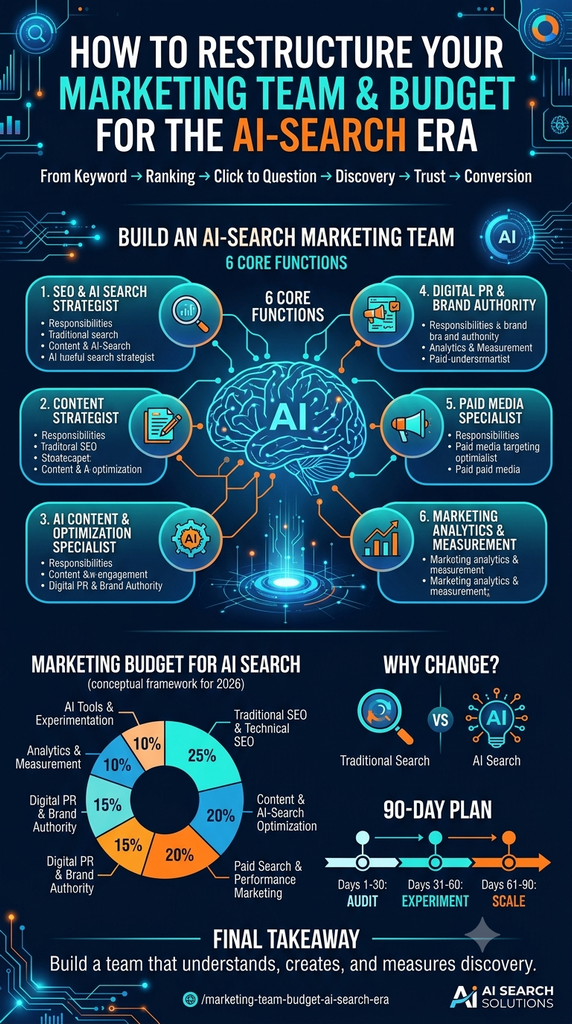
A modern team can be organized into six core functions.
1. SEO & AI Search Strategist
The SEO specialist should no longer focus exclusively on traditional rankings.
Their responsibilities can include:
- Keyword research
- Search-intent analysis
- Technical SEO
- Internal linking
- Content optimization
- AI-search visibility research
- Competitor analysis
- Search Console analysis
- AI citation monitoring
- Topic and entity mapping
The goal is to understand both where your website ranks and where your brand appears in AI-driven search experiences.
Google itself has introduced additional resources and Search Console capabilities intended to help website owners understand changes related to AI in Search.
2. Content Strategist
AI search increases the importance of useful, original and well-structured content.
Your content strategist should identify questions customers actually ask.
Instead of creating 20 articles simply because 20 keywords have search volume, build content around customer journeys.
For example:
Awareness
“What is digital marketing?”
Consideration
“How much does digital marketing cost for a small business?”
Comparison
“Freelance digital marketer vs digital marketing agency”
Decision
“How do I choose a digital marketer in Kochi?”
Action
“Digital marketing consultation for small businesses”
This creates a content ecosystem rather than a collection of disconnected blog posts.
3. AI Content & Optimization Specialist
AI can make content production faster, but speed should not become the main objective.
A good AI-assisted workflow is:
Research → Human expertise → AI assistance → Fact checking → Editing → Original insights → Optimization → Publishing
AI can help with:
- Content briefs
- Topic research
- Content outlines
- Data organization
- Repurposing
- First drafts
- Content gap analysis
- FAQ generation
- Internal-link suggestions
But human review remains important.
Your content should demonstrate:
- Experience
- Original examples
- First-hand insights
- Accurate information
- Clear explanations
- Useful evidence
- Strong brand perspective
The objective is not to publish the largest possible amount of AI-generated content.
The objective is to create content that is useful enough to earn attention and trust.
4. Digital PR & Brand Authority
AI search makes brand authority increasingly important.
Your website is not the only place where your brand exists.
Customers and search systems may encounter your business through:
- News websites
- Industry publications
- Reviews
- YouTube
- Social platforms
- Business directories
- Expert interviews
- Podcasts
- Partner websites
- Community discussions
This means SEO and digital PR should work together.
For example, instead of spending your entire content budget creating another generic article, part of the budget could support:
Original research → Expert commentary → PR outreach → Industry mentions → Website content → Social distribution
That creates multiple signals around the same subject.
5. Paid Media Specialist
AI search does not eliminate paid advertising.
In fact, paid media becomes even more important when organic discovery is changing.
Google is also introducing AI-powered bidding and budgeting capabilities for Search and Shopping campaigns. Its 2026 announcements include demand-led pacing and other automation designed to adjust advertising spend according to changing consumer demand.
Your paid media team should therefore focus less on manual campaign maintenance and more on:
- Conversion quality
- Audience signals
- Creative testing
- Landing-page performance
- Customer lifetime value
- Incremental growth
- Budget allocation
- First-party data
AI can automate many operational tasks, allowing marketers to spend more time on strategy.
6. Marketing Analytics & Measurement
This may become one of the most important roles in the AI-search era.
Why?
Because clicks alone don’t tell the whole story.
A business might experience:
- Lower organic clicks
- Higher brand searches
- More direct traffic
- More branded conversions
- Increased AI citations
- More referral traffic from AI platforms
- Higher conversion rates from fewer visitors
If your team only watches organic sessions, you may misunderstand what is happening.
Your measurement system should track several layers.
Traditional SEO metrics
- Rankings
- Organic impressions
- Organic clicks
- CTR
- Organic conversions
- Revenue
AI-search metrics
- AI mentions
- AI citations
- Citation frequency
- Share of AI visibility
- Brand inclusion in relevant answers
- Referral traffic from AI platforms
- Assisted conversions
Business metrics
- Leads
- Sales
- Revenue
- Customer acquisition cost
- Customer lifetime value
- Conversion rate
- Return on marketing investment
The exact measurement framework will vary by business and platform. AI-search measurement is still developing, so teams should avoid treating any single visibility metric as a universal KPI.
How Should You Restructure Your Marketing Budget?
Don’t simply move your entire SEO budget into AI.
Instead, create a search portfolio.
A practical starting framework could look like this:
| Marketing Area | Example Budget Share |
|---|---|
| Traditional SEO & Technical SEO | 25% |
| Content & AI-search optimization | 20% |
| Paid Search & Performance Marketing | 20% |
| Digital PR & Brand Authority | 15% |
| Analytics & Measurement | 10% |
| AI Tools & Experimentation | 10% |
These percentages are not universal rules.
Your actual allocation should depend on your industry, business model, existing organic visibility, customer acquisition costs, competition, and conversion economics.
The important change is conceptual:
Don’t treat SEO as the entire search budget anymore.
Treat SEO as one part of a broader AI-search and discovery budget.
Start With Your Existing Budget
You don’t always need more money.
First, audit where your current budget is going.
Ask:
Are we spending too much on low-value content?
If your team produces dozens of generic articles every month, reduce quantity and invest more in depth and originality.
Are we measuring only Google rankings?
Add AI visibility, brand searches, conversions and other meaningful business outcomes.
Are we paying for too many disconnected tools?
Audit your software stack.
If five tools perform overlapping functions, consolidate them.
Are SEO and content teams working separately?
Connect them.
Content should be created from search intent and business priorities, not just a list of keywords.
Are paid and organic teams sharing data?
They should.
Paid search can reveal valuable commercial queries and customer language that can inform organic content.
Don’t Cut Traditional SEO Too Quickly
One of the biggest mistakes businesses can make is assuming that AI search means traditional SEO is dead.
It isn’t.
Google’s AI Search still connects users with websites and original content. Google has repeatedly emphasized links and web content as part of its AI Search experience.
Technical SEO still matters.
Your website still needs to be:
- Crawlable
- Indexable
- Fast
- Mobile-friendly
- Well structured
- Internally linked
- Clear about entities and topics
- Useful to visitors
The strategy should evolve rather than disappear.
Create an AI-Search Content Workflow
Your new content process could look like this:
Step 1: Identify the customer problem
Start with what your customer needs, not just a keyword.
Step 2: Research the search landscape
Analyze Google results, AI search results, competitors, forums, reviews and customer questions.
Step 3: Identify content gaps
Find questions that existing competitors answer poorly.
Step 4: Add original expertise
Include:
- Examples
- Data
- Case studies
- Expert opinions
- First-hand experiences
- Original research
Step 5: Structure the content clearly
Use:
- Descriptive headings
- Short paragraphs
- Lists
- Tables where appropriate
- FAQs
- Definitions
- Step-by-step explanations
Step 6: Optimize technically
Check:
- Metadata
- Internal links
- Schema where appropriate
- Page speed
- Indexability
- Images
- Mobile usability
Step 7: Distribute
Repurpose the content into:
- LinkedIn posts
- YouTube videos
- Short-form videos
- Email newsletters
- Expert interviews
- PR content
Step 8: Measure
Track rankings, traffic, conversions and AI visibility.
Then improve the content.
A Better Way to Think About Your Marketing Team
The AI-search era isn’t necessarily about building a huge AI department.
It’s about changing how existing specialists work together.
Instead of:
SEO → Content → Social → Ads
think:
Customer insight → Content → SEO → AI visibility → Distribution → Paid amplification → Conversion → Analytics → Optimization
This creates a connected marketing system.
What Skills Should Marketers Develop?
Your team should gradually build skills in:
AI literacy
Understand how generative AI systems work and where their limitations are.
Search intent
Understand why someone searches, not just what they search.
Content strategy
Create useful resources instead of publishing content simply to fill a calendar.
Data analysis
Connect marketing activity with actual business results.
Prompting and AI workflows
Use AI to improve research, analysis and production without removing human quality control.
Brand building
Develop recognizable expertise and authority beyond search rankings.
Conversion optimization
Getting visibility is only the first step. The visitor still needs a reason to become a customer.
A 90-Day Plan for Restructuring Your Marketing Team
You don’t need to rebuild everything overnight.
Days 1–30: Audit
Review:
- Current team structure
- SEO performance
- Content performance
- Paid advertising
- AI visibility
- Marketing tools
- Budget allocation
- Conversion data
Identify what is working and what is producing little business value.
Days 31–60: Experiment
Choose a small group of important topics.
Test:
- AI-search-focused content
- FAQ-driven content
- Original research
- Expert-led articles
- Digital PR
- AI visibility monitoring
Compare results against your existing strategy.
Days 61–90: Scale
Keep the activities that produce meaningful results.
Then:
- Reallocate budget
- Update team responsibilities
- Build repeatable workflows
- Create AI-search KPIs
- Invest in high-performing channels
This reduces the risk of making a major budget decision based on assumptions.
The Biggest Budgeting Mistake to Avoid
Don’t spend your entire budget chasing the newest AI platform.
AI search is changing quickly.
A tool that is valuable today may become less important tomorrow.
Instead, invest in capabilities that remain valuable regardless of which platform wins:
Strong content.
Original expertise.
Technical SEO.
Brand authority.
First-party data.
Analytics.
Customer understanding.
These assets can support your marketing strategy across Google, AI search engines, social platforms and other discovery channels.
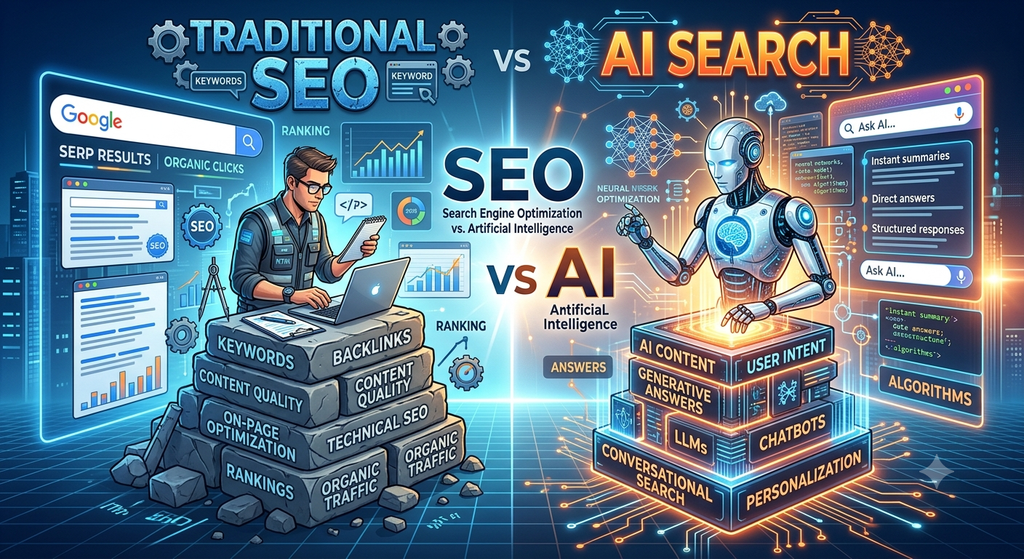
The Future of Marketing Is Not “SEO vs AI”
The better question is:
How can SEO, AI search, content, brand building, paid media and analytics work together?
Google’s own 2026 Search updates show how quickly the search experience is evolving. AI Mode has grown to more than one billion monthly users, and Google says AI-powered features are contributing to increased Search usage.
That doesn’t mean every business should immediately double its AI budget.
It means marketing leaders should start testing the new environment before making major resource decisions.
A freelance digital marketer helps businesses grow online through effective SEO, social media marketing, content marketing, and digital advertising strategies. Unlike traditional agencies, a freelance digital marketer offers personalized solutions based on a business’s goals, target audience, and budget. By combining creativity, data-driven strategies, and continuous optimization, freelancers can help businesses improve online visibility, attract potential customers, and build long-term digital growth.https://suhailll.com/
Final Takeaway
Restructuring your marketing team for the AI-search era doesn’t mean firing your SEO team or replacing writers with AI.
It means changing the way marketing resources are organized.
Build a team that can:
Understand → Create → Optimize → Build Authority → Distribute → Measure → Improve
And build a