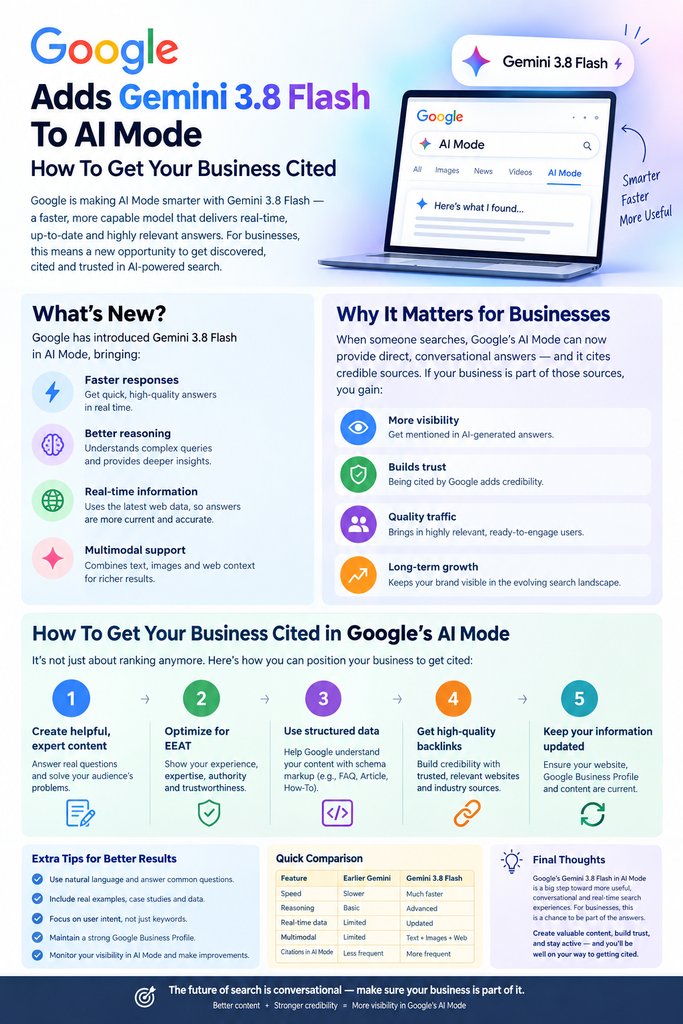
Google just gave AI Mode another upgrade. On September 2, 2026, the company rolled out Gemini 3.8 Flash to AI Mode — its third Flash release in just six weeks. If you’re wondering what this means for your business and, more importantly, how to actually show up when someone searches, you’re in the right place.
I’ve spent the past few weeks testing this model directly in AI Mode and digging into how citation behavior is shifting. Here’s what’s real, what’s hype, and what you should actually do about it.
What Is Gemini 3.8 Flash in AI Mode?
Gemini 3.8 Flash is Google’s newest “workhorse model,” available to Google AI Pro and Ultra subscribers through the “+” icon in AI Mode’s search bar. Google describes it as delivering meaningful gains over Gemini 3.7 Flash in software engineering, agentic tasks, and multi-step reasoning.
What stood out to me isn’t any single feature — it’s the speed-to-usefulness ratio. I tested it for quick research tasks, brainstorming, and follow-up questions, and it didn’t feel like I was trading quality for speed. That’s a notable shift from earlier AI Mode experiences, where getting a genuinely useful answer often meant waiting or re-prompting.
Does Gemini 3.8 Flash Actually Change Who Gets Cited?
This is the question every business owner and marketer actually cares about, and the honest answer is: it’s complicated, and it’s early.
I want to be careful here — I don’t have a clean before/after experiment showing that 3.8 Flash specifically changed citation outcomes for a site I manage. The model is too new for that kind of clean data. But there are patterns worth paying attention to.
A recent study tracking citation overlap found that out of 362 domains cited across Gemini, AI Overviews, and AI Mode, only 9 domains appeared in all three. AI Mode in particular showed high source churn — meaning it doesn’t consistently pull from the same sites, even for similar queries.
Another analysis found that only 10–30% of domains cited by Gemini were ranking in Google’s traditional top 10 for the matching query. That’s a big deal. It tells us AI Mode citation isn’t just a proxy for traditional rankings — a page that directly and clearly answers a specific question can get picked up even if it’s not sitting at position one.
How to Get Your Business Cited in AI Mode
Here’s where I’d focus if I were advising a client today.
1. Write Answer-First, Genuinely Useful Content
Don’t build pages around a keyword — build them around a question. Put your clearest answer near the top, then back it up with specifics: real examples, comparisons, and insight that isn’t just a repeat of what’s already ranking.
2. Build Topical Authority, Not Scattered Keyword Pages
Instead of dozens of loosely related articles, build a focused cluster of content around a subject you can credibly speak to. Support your claims with trustworthy sources, and make sure the site as a whole signals real expertise in that space — not just one lucky page.
3. Make Your Content Easy to Extract and Verify
Use clear headings, concise sections, structured data where it applies, and strong internal linking. Keep your key information in crawlable HTML — not locked inside images or JavaScript-rendered elements AI systems can’t easily parse.
Google itself has said there’s no special “AI schema” or AI-specific file needed for AI Overviews or AI Mode. The foundational SEO principles still apply.
The Biggest Mistake Businesses Make
The mistake I see most often: trying to optimize for AI instead of becoming a source AI has a reason to cite.
That usually shows up as stuffing exact-answer phrases into content, obsessing over invented “AI-specific” schema, or mass-producing generic AI-written pages. None of that builds the kind of original, trustworthy content these systems are actually looking for.
Instead, focus on:
- Original information — first-hand experience, data, or examples competitors aren’t just repeating
- Clear, direct answers supported by useful detail
- Strong fundamentals — crawlability, indexing, accessible text, accurate structured data
- Real value beyond the summary — AI Mode is designed to surface links worth exploring further, so your page needs to offer something worth the click
The mindset shift I tell every client: stop asking “How do I trick AI into citing me?” and start asking “What information can my site provide that the AI needs to find?”
Content Formats That Tend to Get Picked Up
Format alone doesn’t guarantee a citation — but formats that make information easy to extract as a self-contained answer perform noticeably better. A 2026 Semrush study found strong associations between AI citations and clear summarization, Q&A structure, section organization, and structured data, with Q&A format showing a +25.45% association with citations.
Formats worth prioritizing:
| Format | Why It Works |
| Q&A / FAQ sections | Matches direct question-based queries |
| Comparison tables (HTML, not images) | Individual cells offer self-contained facts |
| Step-by-step guides | Numbered steps preserve sequence and context |
| Short answer + deeper explanation | Clear summarization was the strongest citation signal in the study |
| Bulleted checklists | Each bullet stands independently and is easy to extract |
One caveat: don’t confuse Google’s FAQ rich-result eligibility (which no longer displays in standard Search) with being useful source material for AI systems — they’re not the same thing.
A layout that tends to work well for AI Mode: direct answer → key facts → comparison table → step-by-step explanation → FAQs → sources/evidence.
Interestingly, one large 2026 study covering both AI Mode and Gemini found that comparative queries (“X vs Y”) generated substantially more brand mentions than purely informational queries — though citation behavior differed noticeably between the two systems.
FAQs
Does Gemini 3.8 Flash require new SEO tactics?
No. Google has confirmed there’s no special AI-specific schema or file requirement. Foundational SEO — crawlability, clarity, authority — still applies.
Is ranking #1 in traditional Search required to get cited in AI Mode?
No. Research shows a meaningful share of AI Mode citations go to pages outside the traditional top 10, provided they directly and clearly answer the query.
What’s the single biggest lever for getting cited?
Being a genuinely useful, original, and clearly structured source — not chasing “AI optimization” tricks.
Conclusion
Google adding Gemini 3.8 Flash to AI Mode is another sign that AI-powered search isn’t slowing down — and neither should your content strategy. The businesses that get cited aren’t the ones gaming the system; they’re the ones consistently publishing clear, original, well-structured answers that both readers and AI systems can trust.
Start with one thing this week: pick a page that isn’t performing, add a direct answer at the top, and turn a dense paragraph into a table or step list. Small structural changes like that are often the fastest way to become the kind of source AI Mode wants to cite
A freelance digital marketer helps businesses grow online through effective SEO, social media marketing, content marketing, and digital advertising strategies. Unlike traditional agencies, a freelance digital marketer offers personalized solutions based on a business’s goals, target audience, and budget. By combining creativity, data-driven strategies, and continuous optimization, freelancers can help businesses improve online visibility, attract potential customers, and build long-term digital growth.